Some people need more than an hour a week and less than a hospital. Residential care gives them a place to live while they get better, with treatment built into every day.
Many people search “inpatient mental health treatment Georgia” because inpatient is the only word they know for care that goes beyond an appointment. Maybe a weekly therapist has run out of ideas. Perhaps there was an emergency room visit off I-75 last month, a few days of crisis care, and then home to the same house and the same slide. Maybe you are reading this for yourself, or maybe you are reading it about a son, a wife, or a parent who has gone quiet in a way that frightens you.
Kingston Wellness Retreat is a residential mental health treatment center for adults in Kingston, Georgia, about an hour northwest of Atlanta. People live here for a stretch of weeks while they are treated, in a setting that is quiet on purpose. It serves Georgians from metro Atlanta to Rome, and adults who travel in from other states. The first thing to sort out is whether residential is the right level of care.
What Residential Mental Health Treatment Is
Residential treatment is a live-in level of mental health care. A person moves into the program, sleeps and eats there, and spends the day in treatment instead of fitting treatment around a job, a commute, and a household. It sits between two things most families already know: weekly outpatient therapy on one side and a hospital psychiatric unit on the other.
The difference from outpatient care is time. Weekly therapy is one hour out of the 168 in a week. The other 167 happen at home, around the same cues, habits, and stresses that keep the illness going. In residential care, most waking hours are structured around getting better: therapy sessions, groups, meals at set times, sleep at set times, and room to practice new skills with support close by.
The difference from a hospital is purpose. A hospital unit is built to stabilize an emergency, often in a few days. Residential care is built for the treatment that comes after stabilization, the weeks of work that a short hospital stay was never designed to do.
Inpatient, Residential, and What People Mean by Each
People search for inpatient mental health care, residential treatment, a mental health retreat, or a psychiatric facility, and often mean the same thing: somewhere to stay while getting real help. Clinically, the words point to different levels of care.
- Hospital inpatient care: A psychiatric unit in a hospital, usually locked, focused on immediate safety and short-term stabilization. It is the right place when someone is in danger right now.
- Residential treatment: A live-in program for people who are medically and psychiatrically stable enough to engage in daily therapy. It is inpatient-style in the sense that people stay overnight, but the setting and the goals are different. This is what Kingston provides.
- Outpatient care: Therapy and psychiatric visits while living at home. It works well for many people, and it is often the next step after residential treatment ends.
The side-by-side comparison of residential treatment and psychiatric hospitalization goes deeper, and so does the plain-language look at what a psych ward and a mental hospital actually are. If you are trying to judge whether this level is warranted at all, clinicians use a short set of questions about when residential treatment is necessary.
Inside the Facility
Kingston sits in the Etowah River valley in Bartow County, a short drive west of Cartersville and east of Rome. From downtown Atlanta it is a little over an hour up I-75 and out on US-411, far enough from the city to feel like a different place and close enough that family can visit. Hartsfield-Jackson is about an hour and a half away for those who fly in.
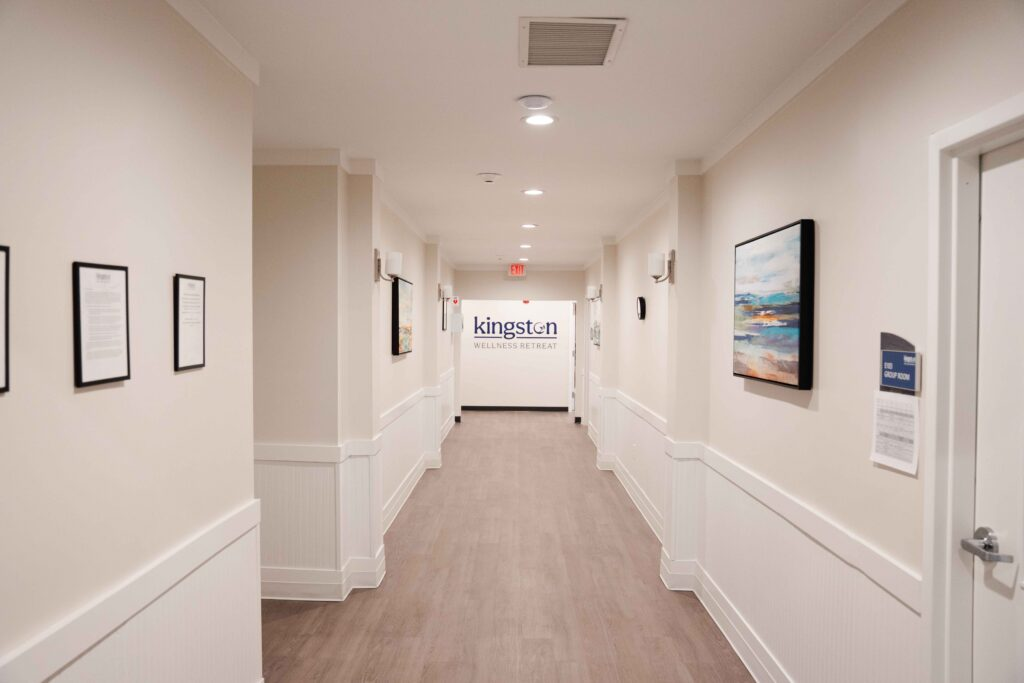
The setting is a retreat rather than a clinic. The retreat model treats the environment as part of the care: a 35 bed smaller program, a quieter setting, and a daily rhythm that lets an overworked nervous system settle. Bedrooms have TVs. Meals come from a private chef. There is a gym, a theater with surround sound, trauma-informed yoga, and a spa with a sauna and cold plunge. Those comforts are there so the hard work of therapy is possible on day 19 as well as day two.
Phone use is decided by the clinical team after admission, based on what each person needs early in treatment. Fewer outside calls at the start can give sleep, appetite, and medication a chance to settle before the outside world comes back in. Admissions can explain how this works before anyone arrives. A tour of our retreat shows the property for anyone who wants to see it first.
A Week of Treatment
Every resident has an individual treatment plan, and every week includes one-to-one therapy with a licensed therapist. Treatment also includes psychiatric care and therapies chosen for the person’s diagnosis and history.
Talk Therapies
- Cognitive behavioral therapy: Works on the thought patterns that keep low mood and anxiety going, and tests them against what is actually true.
- Dialectical behavior therapy: Teaches distress tolerance and emotion regulation, meaning concrete skills for getting through an overwhelming moment without making it worse.
- Family therapy: Helps the household that has been carrying this, and plans for what home looks like afterward.
Body and Nervous-System Approaches
- Trauma-informed and somatic therapy: Body-based work for trauma that talking alone does not reach.
- Neurofeedback and biosound therapy: Approaches aimed at a nervous system that has been stuck on high alert. Alpha-Stim and red light therapy are also available.
- Art and music therapy: Ways to work through experiences that are hard to talk about directly.
Medication and Psychiatry
Psychiatric care runs alongside therapy, so the effects of a medication change are followed while the person is on site rather than judged at an appointment two months later. That matters because antidepressants usually take four to eight weeks to show their full effect, according to the National Institute of Mental Health, and depression is considered treatment-resistant after at least two medications have not helped. Genetic testing can show how a person’s body is likely to process certain medications, which can narrow the options sooner.
Conditions Treated
Kingston is a primary mental health program. Residents commonly come for:
- Depression: Including depression that has not responded to several medications.
- Anxiety disorders: Generalized anxiety, panic disorder, and anxiety severe enough to shrink a person’s life around avoidance.
- PTSD and trauma: Including complex PTSD, the kind that builds over years of repeated harm rather than one event.
- Bipolar disorder: Mood episodes that keep disrupting work, relationships, and sleep.
- Suicidal thoughts: Ongoing thoughts of death or suicide without immediate intent, once any emergency has been handled.
- Dual diagnosis: A mental health condition alongside alcohol or drug use, treated together rather than one at a time.
The full list of mental health programs in Georgia covers more, and admissions can say during a first call whether a particular diagnosis is a good fit.
Who Needs Something Else First
Residential care is for adults who are safe enough to engage in daily treatment. If someone is in danger right now, call 911, or call or text 988. In Georgia, 988 connects to in-state crisis counselors who can talk through the situation and point to local crisis services. A hospital or crisis unit handles the emergency, and residential care can follow once the person is stable. Georgia’s emergency evaluation process, known as a 1013, belongs to that crisis stage too.
When alcohol or drug withdrawal needs medical management, that happens with a detox provider first, and the mental health work can begin at Kingston once the body is steady. For people whose needs fit outpatient care better, admissions will say so and help point the way.
Coming From Atlanta and Across Georgia
For many Georgians, an hour’s drive is the right distance. It is close enough for family therapy and visits, and far enough that a person stops running into the people, places, and pressures that have kept the illness going. Kingston serves adults from Marietta and the rest of Cobb County, from Cartersville and Rome, from Athens, and from towns across Georgia where a residential mental health bed is hard to find close to home. For people with public-facing jobs, being out of town can also make treatment easier to say yes to.
Cost and Insurance
Kingston Wellness Retreat is in-network with Optum/UBH, Cigna, and Curative. Optum and UBH coverage excludes ACA marketplace plans, and details for Optum members and Cigna members are on their own pages. For Cigna ACA and Individual & Family Plans (IFP) in Georgia, a single case agreement may be possible. That is a one-time exception the insurer can approve or decline, and the case must meet SCA requirements and clinical criteria for residential care. Other carriers are handled through out-of-network benefits, which usually means a larger share for the family but does not rule treatment out.
Federal parity law requires most plans that cover mental health to apply rules comparable to those for medical and surgical care, which is why insurance often covers inpatient and residential mental health care. Plans still vary widely. Admissions reviews your specific policy and gives you a realistic picture of costs before any decision is made.
Begin Residential Mental Health Treatment in Georgia at Kingston Wellness Retreat
A first call is a conversation about the past few months: what has been happening, what has been tried, whether there have been hospital stays, and what coverage looks like. From there, admissions can say whether residential care fits and whether this program is the right one, or whether another level of care would serve you better. Partners, parents, and adult children call on someone’s behalf all the time, and asking questions commits nobody to anything. Reach the Kingston Wellness Retreat admissions team when you are ready to talk it through. If anyone is in danger right now, call 911 or call or text 988 first.
FAQs About Residential Mental Health Treatment in Georgia
They overlap but are not identical. Both mean staying overnight at a treatment setting. Hospital inpatient care is short-term and focused on immediate safety, usually on a locked unit. Residential treatment is for people who are stable enough for daily therapy and lasts weeks, in a setting built for treatment rather than emergencies. Kingston Wellness Retreat provides residential care. If someone is in danger right now, a hospital or 911 comes first, and residential care can follow.
Adults 69 and under living with depression, anxiety, PTSD or complex trauma, bipolar disorder, ongoing suicidal thoughts without immediate intent, or a mental health condition alongside substance use, when outpatient care has not been enough. A good fit is someone safe enough to take part in daily therapy who needs more structure and support than home can provide. Admissions talks through each situation and will say plainly if another level of care fits better.
The retreat is in Kingston, Georgia, in Bartow County, between Cartersville and Rome. From downtown Atlanta it is a little over an hour by I-75 and US-411, depending on traffic, and Hartsfield-Jackson is about an hour and a half away for families who fly in. Cartersville and Rome are each roughly 20 to 30 minutes away. The setting is rural and quiet on purpose, and admissions can answer questions about the property before you decide.
Often, depending on the plan. Kingston Wellness Retreat is in-network with Optum/UBH (excluding ACA marketplace plans), Cigna, and Curative. For Cigna ACA and Individual & Family Plans in Georgia, a single case agreement may be possible if the case meets SCA requirements and clinical criteria for residential care. Other carriers are handled through out-of-network benefits. Federal parity law generally requires comparable coverage rules for mental health and medical care. Admissions reviews your actual policy and explains likely costs before you decide.
Sources
- National Institute of Mental Health. (n.d.). Depression. Retrieved from: https://www.nimh.nih.gov/health/publications/depression. Accessed on October 27, 2026.
- National Institute of Mental Health. (n.d.). Anxiety disorders. Retrieved from: https://www.nimh.nih.gov/health/topics/anxiety-disorders. Accessed on October 27, 2026.
- National Institute of Mental Health. (n.d.). Post-traumatic stress disorder (PTSD). Retrieved from: https://www.nimh.nih.gov/health/publications/post-traumatic-stress-disorder-ptsd. Accessed on October 27, 2026.
- Substance Abuse and Mental Health Services Administration. (n.d.). Co-occurring disorders. Retrieved from: https://www.samhsa.gov/substance-use/treatment/co-occurring-disorders. Accessed on October 27, 2026.
- Georgia Department of Behavioral Health and Developmental Disabilities. (n.d.). 988 in Georgia. Retrieved from: https://dbhdd.georgia.gov/be-dbhdd/988-georgia. Accessed on October 27, 2026.
- Centers for Medicare & Medicaid Services. (n.d.). The Mental Health Parity and Addiction Equity Act (MHPAEA). Retrieved from: https://www.cms.gov/marketplace/private-health-insurance/mental-health-parity-addiction-equity. Accessed on October 27, 2026.
Overview
- Level of care: Residential mental health treatment, sometimes searched as inpatient mental health care. Adults live on site for the length of their stay.
- Who it is for: Adults 69 and under with depression, anxiety, trauma, bipolar disorder, or other mental health conditions that have not improved enough with weekly outpatient care.
- Where it is: Kingston, Georgia, in Bartow County, between Cartersville and Rome. About an hour northwest of downtown Atlanta.
- What a day holds: Individual and group therapy, psychiatric care, nervous-system therapies, family therapy, and a set daily rhythm, in a small retreat setting rather than a hospital ward.
- Coverage: In-network with Optum/UBH (ACA marketplace plans excluded), Cigna, and Curative. A single case agreement may be possible for Cigna ACA and IFP plans in Georgia, subject to SCA requirements and clinical criteria. Out-of-network benefits accepted for other carriers.