
For people in Miami-Dade who need a genuinely quiet setting and residential mental health treatment for Miami residents built around mental health rather than addiction, the nearest fit is often not in Florida.
- Where it is: Kingston, Georgia, in Bartow County. Roughly two hours from Miami International to Atlanta, plus an hour northwest by road. About 10 hours if driving.
- What it is: Retreat-style residential mental health treatment for adults. Voluntary, unlocked, and primary mental health rather than substance use.
- Why Miami families call: Privacy in a city where social and professional circles overlap heavily, and a low-stimulation environment that South Florida cannot offer.
- Coverage: In-network with Optum and UBH. Out-of-network accepted with other carriers; a single case agreement may be attempted for HMO and EPO plans.
- Language and family: Miami households are frequently multigenerational and multilingual, and family involvement is treated as part of the clinical work rather than a visiting policy.
Miami is a city that rewards intensity. The hours are long, the social calendar is not optional in a lot of industries, and there is a widely shared understanding that you keep going. That works until it does not, and when it stops working the same qualities that made it possible to push through make it very hard to stop and be treated.
Kingston Wellness Retreat provides residential mental health treatment for Florida residents on a quiet property in Bartow County, Georgia, and Florida is among the states we serve. Whether you are the person who has been running on empty since the spring or the family member who has watched it happen from across a dinner table, the honest starting point is the distance and why anyone would cross it.
What Miami Makes Hard
Two things about this city shape how a mental health condition progresses here, and neither gets said out loud very often.
The first is that everyone knows everyone. Miami’s professional worlds, in finance, law, real estate, medicine, hospitality, and the arts, are dense and interconnected in ways that surprise people who move here from larger, more anonymous cities. A person weighing several weeks of treatment is reasonably calculating who will notice, who will ask, and what gets said. That is not vanity. In a reputation economy it is a rational concern, and it delays care by months and sometimes years.
The second is that there is nowhere quiet. This sounds trivial and is not. Recovery from a sustained period of high alert involves a nervous system learning that it can stand down, and that learning happens faster in an environment that is not itself stimulating. South Florida is many wonderful things; low-stimulation is not among them. Heat, light, traffic, noise, and a social density that does not let up are all working against the exact thing treatment is trying to produce.
There is a third factor that is structural rather than cultural. Florida’s residential treatment landscape skews heavily toward substance use, which is a different problem. An adult whose issue is complex trauma or treatment-resistant depression without an addiction component often finds the options thinner than the raw number of facilities suggests.
The Journey, Honestly
Most people fly. Miami International to Hartsfield-Jackson is around two hours in the air, and Kingston is roughly an hour northwest of the Atlanta terminals, up I-75 and out along US-411 past Cartersville. Door to door it is most of a day but not a difficult one.
Driving is around ten hours: Florida’s Turnpike north to I-75 at Wildwood, then the long run through Ocala, Gainesville, Valdosta, and Macon before the Atlanta metro. Some families fly the person up and drive a car separately when a stay is going to run several weeks.
Clinicians do not treat that distance as pure cost, and this is worth sitting with rather than skimming. A condition builds itself into a particular life: the same drive up Brickell, the same group chat, the same room at midnight. Treatment inside that architecture spends half its energy fighting the architecture. Distance interrupts it in a way that no amount of willpower does at home.
It is also a real disruption at real expense, and it should be weighed as one. For a great many Miami adults the appropriate answer is care closer to home, and an honest assessment will say so.
What the Retreat Setting Is Actually For
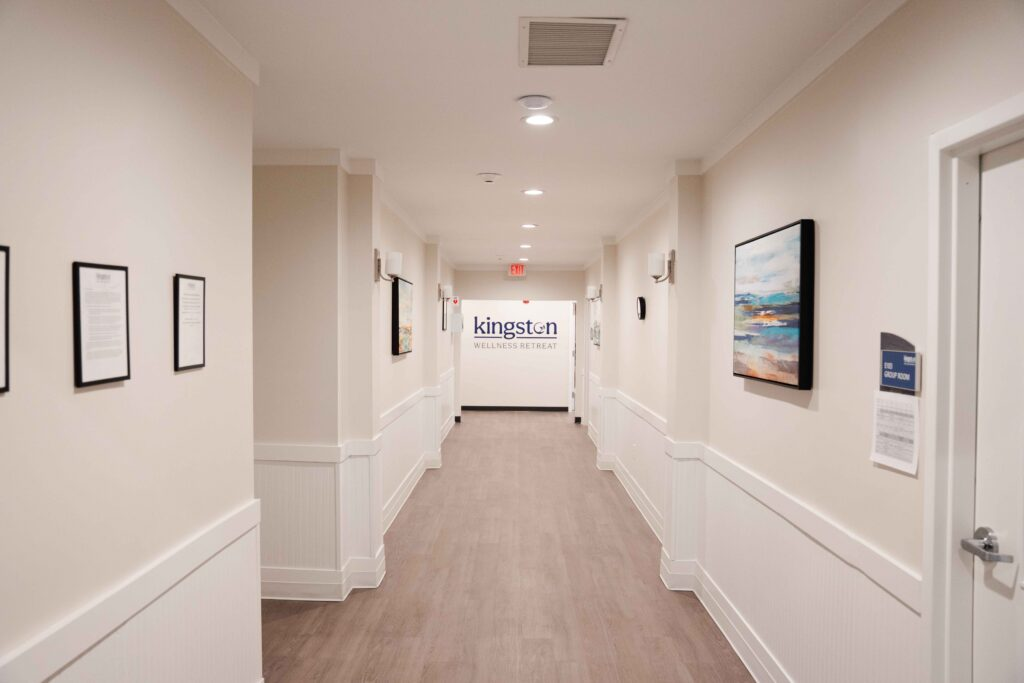
Kingston sits on a quiet property in the North Georgia hills, up the Etowah River valley from Cartersville, with Rome further west and Atlanta an hour southeast. The word retreat here describes a clinical position rather than a marketing register: the physical environment is treated as part of the treatment rather than the container it happens in.
In practice that means space, a smaller and more reflective setting than a large campus, and a daily rhythm that has room in it. Comfort is treated as clinical rather than decorative. A private chef, a gym, a sauna and cold plunge, a theater, and trauma-informed yoga exist because physical calm makes difficult therapeutic work possible, and an adult who feels treated like a person participates differently from one who feels processed.
The seasons do some work too, and Miami residents notice it more than most. The North Georgia autumn and winter mark time in a way South Florida does not, and for some people a genuine change of season is part of what makes a stretch of treatment feel like a distinct chapter rather than more of the same year.
The Clinical Work
Underneath the setting, the treatment is conventional, evidence-based, and delivered at residential density.
Cognitive behavioral therapy works on thought patterns that have hardened into rules a person stopped questioning years ago. Dialectical behavior therapy teaches distress tolerance and emotion regulation, meaning concrete things to do when a feeling arrives faster than any reasoning can catch it. Neurofeedback and biosound therapy address a nervous system that has been stuck in alarm long enough that calm no longer registers as normal.
Psychiatric care runs alongside, with medication managed under daily observation rather than assessed retrospectively at quarterly appointments, and genetic testing narrowing which medications a person’s body is likely to tolerate.
Conditions treated include complex trauma, depression, severe anxiety, bipolar disorder, and suicidal ideation that persists without immediate intent. Where substance use sits alongside a mental health condition, dual diagnosis care addresses both together.
Family, Which Miami Households Take Seriously
A lot of Miami families are multigenerational and closely involved by default, and that involvement is an asset rather than a complication.
Family therapy is treated as part of the clinical work rather than a visiting hour. A household reorganizes itself around a serious illness over months and years, and that reorganization has its own patterns that need unwinding, whether or not the person who was ill gets better. Sessions can be arranged remotely for relatives who cannot travel, which matters when parents or grandparents are in another country as well as another state.
It is also worth saying plainly that a family who wants to be involved is a good prognostic sign and gets treated that way, not as an obstacle to be managed.
Coverage From Miami-Dade
Network status attaches to the plan rather than the state line. Kingston Wellness Retreat is in-network with Optum and UBH. Out-of-network arrangements are accepted with other carriers, and for HMO and EPO plans a single case agreement may be attempted, which is a negotiated one-off rather than something anyone can promise in advance.
Federal parity law requires most plans covering mental health benefits to apply comparable rules to them as to medical and surgical care. Out-of-network coverage varies enormously between policies, though, so a general answer here would be useless. Our team reads your specific policy and gives you a realistic picture of what it pays and what your exposure looks like, before an assessment rather than after one.
From Miami, the First Question Is Fit
Nobody should book a flight before knowing whether this is the right kind of program for the situation, and that is a conversation rather than a research project. A clinician hears what the past six months have actually looked like and says plainly whether residential care is proportionate, whether this setting suits, or whether something in Miami-Dade would serve better. If privacy is the thing that has been holding this up, ask about it directly and get a straight answer. Family members phone and ask their own questions first, which is a normal way to begin. Reach the Kingston Wellness Retreat admissions team and we will go through benefits, travel, and what arriving involves. If someone is in danger tonight, call 911 or 988 first.
FAQs About Residential Mental Health Treatment for Miami Residents in Georgia
Roughly two hours in the air from Miami International to Hartsfield-Jackson, then about an hour northwest by road up I-75 and out on US-411 past Cartersville. Door to door it is most of a day. Driving is around ten hours, taking Florida’s Turnpike north to I-75 at Wildwood and then the long run through Ocala, Gainesville, Valdosta, and Macon. Some families fly the person up and drive a car separately when the stay will run several weeks.
Health information is protected by law, and treatment records cannot be shared without consent. Beyond the legal position, the practical answer for someone worried about a dense professional network is that treatment is happening several states away from it. If privacy is your main concern, raise it directly on a first call and get specifics rather than reassurance. It is a common and entirely reasonable question, particularly from people in Miami’s more interconnected industries.
Yes, and it is treated as part of the clinical work rather than a courtesy. Family therapy is a scheduled component, because a household reorganizes itself around a serious illness over months and years and those patterns need their own repair. Sessions can be arranged remotely for relatives who cannot travel, which matters when family members are in another country as well as another state. A family who wants to be involved is a good sign clinically, not an obstacle.
No. It is a primary mental health program treating depression, severe anxiety, PTSD and complex trauma, bipolar disorder, and persistent suicidal ideation. Where substance use is present alongside a mental health condition, dual diagnosis care addresses both together. Somebody whose main need is medically supervised withdrawal or addiction-focused residential treatment is better served elsewhere, and an assessment will say so rather than admitting a poor fit. That distinction is part of why some Florida families look out of state in the first place.
Sources
- Florida Department of Children and Families. (n.d.). System of services and support. Retrieved from: https://www.myflfamilies.com/services/samh/treatment-services/AMH/system-of-services-and-support. Accessed on September 14, 2026.
- National Institute of Mental Health. (n.d.). Mental illness statistics. Retrieved from: https://www.nimh.nih.gov/health/statistics/mental-illness. Accessed on September 14, 2026.
- National Institute of Mental Health. (n.d.). Anxiety disorders. Retrieved from: https://www.nimh.nih.gov/health/topics/anxiety-disorders. Accessed on September 14, 2026.
- National Institute of Mental Health. (n.d.). Post-traumatic stress disorder (PTSD). Retrieved from: https://www.nimh.nih.gov/health/publications/post-traumatic-stress-disorder-ptsd. Accessed on September 14, 2026.
- U.S. Department of Health & Human Services, Office of Minority Health. (2024). Mental and behavioral health. Retrieved from: https://minorityhealth.hhs.gov/mental-and-behavioral-health. Accessed on September 14, 2026.
- Centers for Medicare & Medicaid Services. (n.d.). The Mental Health Parity and Addiction Equity Act (MHPAEA). Retrieved from: https://www.cms.gov/marketplace/private-health-insurance/mental-health-parity-addiction-equity. Accessed on September 14, 2026.