
Plenty of crises never produce a night anyone can point to. They take months, the household quietly rearranges itself around them, and by the time somebody says the word out loud, everyone involved is worn through.
Ask a family in Bartow County when it started and most of them cannot tell you. There was no siren and no night the neighbors would remember. There was a spring when somebody stopped answering the group text. A summer when the mower stayed in the shed. A fall when the good plates stopped coming out, because nobody was coming over anymore. Somewhere in there a bedroom door started staying shut past noon, and the whole house learned to walk past it quietly.
If tonight is a different kind of night, if someone has been hurt or is in danger right now, that is a 911 call. For anyone struggling or having thoughts of suicide, the 988 Suicide and Crisis Lifeline takes calls and texts at 988 and chat at 988lifeline.org, and the National Institute of Mental Health draws exactly that line between the two numbers. Everything else can wait until that part is handled.
The calls that come in here, though, are almost never about tonight. It is month 11 of something that has never once looked like an emergency and has still taken over a family’s life. That version has no anniversary, no photograph, and no obvious moment where anyone should have acted. It is also the version that most often ends up in residential mental health treatment, sitting an hour north of Atlanta in a farm county most Georgians only know from the exit signs.
The Crisis Nobody Can Put a Date On
If you have spent months telling yourself you are probably overreacting, the clinical definitions are on your side. They are built around how long something has lasted, not how loud it got.
The National Institute of Mental Health sets the bar for major depression at two weeks of symptoms that show up most of the day on most days. Persistent depressive disorder, sometimes called dysthymia, describes milder symptoms that run much longer, usually two years or more. Read those two definitions next to each other and something obvious falls out. The medical language for these conditions is a language of duration. Nothing in it requires an event.
The federal category that best describes what most families are actually watching says the same thing in different words. Serious mental illness, in NIMH’s framing, is a mental, behavioral, or emotional disorder severe enough that it substantially limits at least one major life activity. Work. School. Sleeping and eating. Answering a phone. In 2022, an estimated 15.4 million American adults met that description, about 6 percent of adults. Not one word of that definition is about drama. All of it is about a life getting smaller.
Which explains a cruel piece of how help gets handed out. Somebody who is loud for one night often gets attention inside 24 hours. Somebody who is quiet for a year can go untouched, still holding a job, still showing up at church, still answering fine when asked. Severity and visibility are two different measurements, and they come apart all the time.
What Six Months of Holding It Together Looks Like
Nobody sits down and decides to reorganize a household around an illness. It happens one small reasonable accommodation at a time, and each one, on its own, is the obviously kind thing to do. You take over the pharmacy runs because the line is long and they are tired. Then you start driving because they got shaky on I-75 that once. You stop inviting people because the last time was uncomfortable for everybody. Six months later there is a whole second job nobody applied for, and somebody in the family is quietly failing at their own life to keep this one running.
This is not a diagnostic checklist, and none of it replaces an evaluation. It is simply what the slow version tends to look like from a kitchen table, and it is the pattern people describe on a first phone call.
- The week has gotten smaller without anyone deciding it should: Places they used to go, people they used to see, and errands they used to run have dropped off one at a time until the map of a normal week fits inside one house.
- Somebody else absorbed the basics: Meals, mail, appointments, the dog, the bills. The work did not disappear. It moved.
- The medication history is longer than the improvement: Antidepressants generally need four to eight weeks to show what they can do, and NIMH defines treatment-resistant depression as not improving after trying at least two of them. Three honest trials is most of a year on the calendar. Families feel that year as failure. It is closer to arithmetic.
- The house has rules nobody wrote down: Subjects that do not get raised, hours when nobody knocks, a tone of voice everyone has learned to use in the hallway.
- Sleep has come unhooked from the clock: Awake from 3 a.m. to dawn, asleep through the afternoon, or in bed for 14 hours and rested by none of them.
- They have stopped narrating their own life: The updates got shorter, then vague, then stopped. Fine is now a complete sentence and the end of the conversation.
NIMH lists becoming withdrawn or detached, isolating from family and friends, and being unable to meet responsibilities among the behavior changes that can accompany depression. Thoughts of death or suicide sit on NIMH’s main symptom list. Some of the quietest people in this pattern are carrying passive suicidal thoughts, meaning a wish not to wake up, or a sense that everyone would be better off, without any plan attached. That is worth asking about directly, and asking has never been what puts the idea in someone’s head.
Why It Never Feels Bad Enough to Leave Home
Here is the sentence we hear most often, usually early in a first call: we are probably not bad enough for this. It comes from people whose last six months would exhaust anyone, and it is worth taking apart, because two completely different questions are getting jammed into one.
The First Question is About Tonight. Is Anyone in Danger Right Now?
That question belongs to 911, to 988, and to an emergency department, and it gets answered in hours. The second question is about the last half year. Has this outgrown what an hour a week can carry? That one is a level-of-care question, and severity on any single night is nearly useless for answering it. A person can be in no danger whatsoever tonight and still be losing a year.
Run the Honest Math Instead
Outpatient therapy at its most common frequency is one hour out of the 168 in a week. The other 167 happen in the same house, with the same stairs, the same phone, the same 4 p.m. dread, and the same people trying not to say the wrong thing. When someone is well enough for that arrangement, it is by far the better one. When they are not, adding a second weekly hour rarely changes the outcome. What changes the outcome is taking the environment off the table for a stretch and putting the hours where the illness actually lives.
Rural Georgia Makes That Harder in Ways That Are Not the Family’s Fault
Georgia’s behavioral health department, DBHDD, reports that between 2019 and 2020, suicides declined slightly in the state’s urban areas while rural suicides rose 8.3 percent. Out here past Adairsville and Rome the practical reasons are unglamorous: fewer prescribers, longer waits, more driving, and a much shorter distance between your business and everyone else’s knowledge of it. Then there is the hardest version of all, which is loving someone who does not want help and cannot be made to want it. Wanting it on their behalf is not the same as doing nothing.
The Gap Between Stabilized and Well
For some families the slow crisis does eventually produce one bad night, and that night ends in an emergency department off I-75. Two days later everyone is home again, the house is exactly as it was, and nobody can explain why it does not feel like anything got fixed. That feeling is accurate. Something real happened, and it was not treatment.
Emergency Departments Do a Specific Set of Things Extremely Well
This is not a complaint about them. They rule out the medical problems that impersonate psychiatric ones, and there are more of those than people expect. NIMH notes that conditions such as viruses and thyroid disorders, along with certain medications, can produce the same symptoms as depression. An ED can keep a person physically safe while the acute danger passes, complete a psychiatric evaluation, and begin the search for a psychiatric inpatient bed when one is warranted. In Georgia this is also where families meet the 1013, the state’s paperwork for an emergency psychiatric examination, and it helps enormously to understand what a 1013 actually authorizes before you are standing in a hallway trying to read one.
What an Emergency Department Cannot Do is the Month That Comes After
It is measured on whether a person walks out alive and medically stable, and by that measure it usually succeeds. Then comes the discharge folder, a list of phone numbers, and a first available appointment that in a lot of northwest Georgia counties is weeks away. Stabilized and well are two different words doing two different jobs. Stabilized means the danger passed. Well means the illness got treated. Put NIMH’s own timeline against a 48-hour stay and the gap stops being an opinion: a medication trial takes four to eight weeks to show anything, and the definition of treatment-resistant depression requires two of them. No emergency visit on earth can do that work, and it was never asked to.
How Residential Care Fills the Gap
That gap is the entire argument for residential care, and it is worth stating the limits of ours plainly. Kingston Wellness Retreat is not an emergency service. Acute danger goes to 911, 988, or an emergency department first, every time. Residential mental health treatment is what belongs after that, or instead of a pattern where repeat crises become the only care anyone ever receives. It also does not look like the thing most people are picturing, and the difference between a locked hospital unit and a residential program is worth knowing before fear makes the decision for you.
What Residential Mental Health Care Looks Like at Kingston
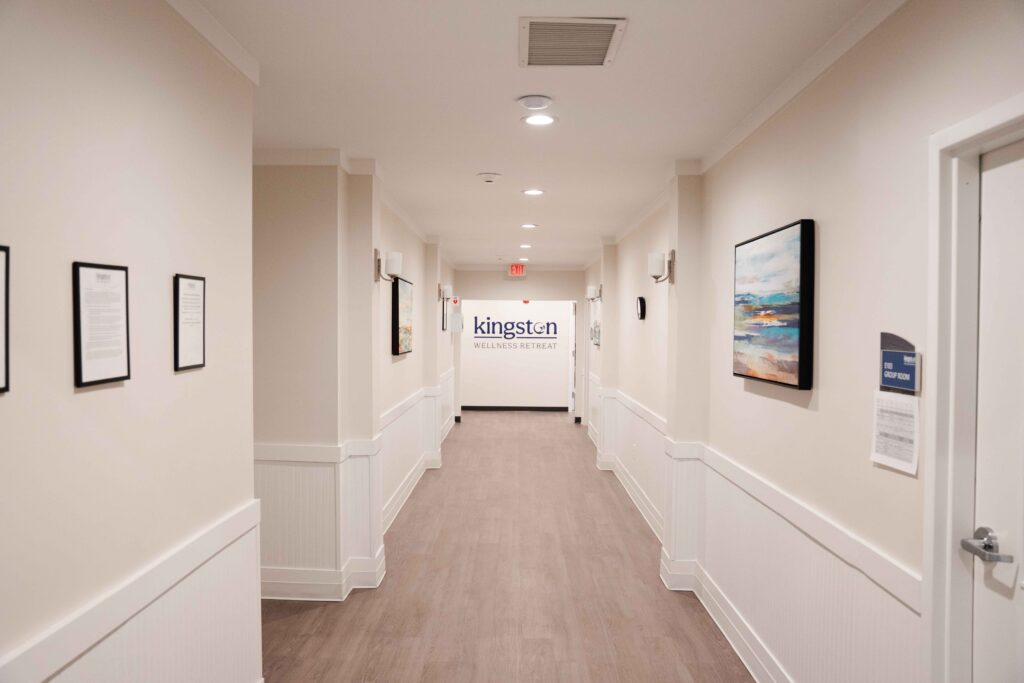
Kingston sits in Bartow County off US-411, west of Cartersville, near enough to the Etowah River that you can hear how quiet it is out here. Rome is 30 minutes west, Atlanta and Hartsfield-Jackson a bit over an hour south down I-75. People live on the grounds for a stretch of weeks. That is the whole structural difference, and it is a bigger difference than it sounds like.
Physician-Led and Psychiatric Care
Care here is physician-led, and psychiatric care runs in parallel with therapy instead of on a separate track. Every week includes a one-to-one hour with a master’s-level clinician. The rest of the days are group work, and none of it gets negotiated on arrival, because the calendar is already built. Deciding what to do with a Tuesday is expensive when a person is ill, and handing that decision to somebody else frees up the only fuel they have left. Kingston treats mental health conditions. It is not a detox program, and admissions says so on the first call instead of after a two-hour drive.
Our Therapeutic Approach
The week itself is made of specific things. Cognitive behavioral therapy, which NIMH names among the evidence-based treatments for depression, goes after the loops of thought a low mood keeps replaying. Dialectical behavior therapy teaches a person to sit inside a feeling at full volume without acting on it. Trauma-informed therapy, somatic therapy, and trauma-informed yoga begin with the body, since a year of bracing does not release because someone explained it well. Neurofeedback, biosound therapy, and Alpha-Stim reach the nervous system more directly than talking does, while art therapy and music therapy hold the material that has not turned into language yet.
Family therapy is written into the programming, which matters here, because the household that has been absorbing this for six months has its own adjustments to make. Meals come from a private chef. The spa has a sauna and a cold plunge, and there is a gym and a theater. None of that treats anything. It is there so difficult sessions stay survivable on day 19.
Coverage is the question most families ask third and worry about first. Optum and UBH plans are contracted here, with ACA marketplace policies excluded, and Cigna is in progress. Everything else runs through out-of-network benefits, which generally moves more of the bill toward the family without ending the conversation. Members on an HMO or EPO have one more avenue worth naming honestly: a single case agreement, where an insurer agrees to treat one stay at one facility as an exception to its own network rules. That is a request, not a lever, and no family should be told otherwise.
The First Week, in Plain Terms
Sleep and appetite tend to shift first, because a predictable day reaches them before it reaches anything else. Somebody with actual time sits down with the medication list, genetic testing included, which shows how an individual body is likely to process a given drug. Outside a setting like this, people collect that information one prescription and one disappointing month at a time. Phone contact pauses for 72 hours, then opens daily. That rule troubles families more than anything else on the list, so the reason should be plain: those three days are when sleep and dosing start finding a rhythm, and an inbox full of what is going wrong at home pulls hard against it. The pause is brief, the thinking behind it is medical rather than a matter of discipline, and it ends on schedule.
Where to Start When There Was Never One Bad Night
A first call here is mostly questions, and they are ones you can already answer: what these last several months have actually looked like, what has been tried, whether there have been hospital visits, and how much the coming weeks can realistically absorb. Benefits get checked in the same conversation, and you will be told what the policy authorizes rather than what everybody hopes it might.
Frequently the person dialing is not the person who would move into the room, and picking up a phone on someone else’s behalf is not a betrayal of them. Start through Kingston Wellness Retreat admissions. If a different level of care is the better fit for your situation, you will hear that from us rather than a pitch. If what tonight actually turns on is whether somebody is safe, start with 988 by call or text, and 911 if anyone is in immediate danger. Short of that, asking costs nothing and commits no one to a date or a bed. And if the answer at home right now is that nobody is ready, that is still a real answer. Set it down and pick it back up when the week has room in it.
FAQs About Recognizing the Signs of a Mental Health Crisis
Use duration and function rather than drama. The clinical definitions already work this way: major depression is diagnosed when symptoms are present most of the day, nearly every day, for at least two weeks, and persistent depressive disorder describes milder symptoms lasting two years or more. The federal definition of serious mental illness turns on functional impairment, meaning a condition that substantially interferes with or limits major life activities such as work, school, sleeping, or eating. If the last six months have steadily shrunk someone’s week, that counts, whether or not there was ever an emergency. If anyone is in danger right now, call 911, and reach the 988 Suicide and Crisis Lifeline by call or text at 988.
Because an emergency department is measured on a different outcome than treatment is. Its job is to rule out medical causes, keep a person physically safe while acute danger passes, complete a psychiatric evaluation, and locate an inpatient bed if one is required. Once someone is stable, that job is finished, which is why a two-day stay can end with a discharge folder and a first appointment weeks away. Stabilized and well are not the same thing. A medication trial alone takes four to eight weeks to show results, and treatment-resistant depression is defined as no improvement after at least two antidepressants. Closing that gap is what residential or structured outpatient care is for.
The retreat sits in northwest Georgia, in Bartow County off US-411 just west of Cartersville. Rome is about 30 minutes away, and Atlanta and Hartsfield-Jackson are roughly an hour south by way of I-75. Adults live on the grounds for the length of treatment. Optum and UBH are contracted, with ACA marketplace policies excluded, and Cigna is in progress. Most other carriers are handled as out-of-network, which normally raises what a family pays without eliminating the option, and members on an HMO or EPO may have a single case agreement requested for them. Admissions works from the real policy and puts actual numbers in front of you before anything is signed.
Sources
- National Institute of Mental Health. (n.d.). Depression. Retrieved from: https://www.nimh.nih.gov/health/publications/depression. Accessed on August 17, 2026.
- National Institute of Mental Health. (n.d.). Mental illness. Retrieved from: https://www.nimh.nih.gov/health/statistics/mental-illness. Accessed on August 17, 2026.
- National Institute of Mental Health. (n.d.). Suicide prevention. Retrieved from: https://www.nimh.nih.gov/health/topics/suicide-prevention. Accessed on August 17, 2026.
- Georgia Department of Behavioral Health and Developmental Disabilities. (n.d.). 988 in Georgia. Retrieved from: https://dbhdd.georgia.gov/be-dbhdd/988-georgia. Accessed on August 17, 2026.
- 988 Suicide & Crisis Lifeline. (n.d.). What to expect. Retrieved from: https://988lifeline.org/get-help/what-to-expect/. Accessed on August 17, 2026.